
Superformula
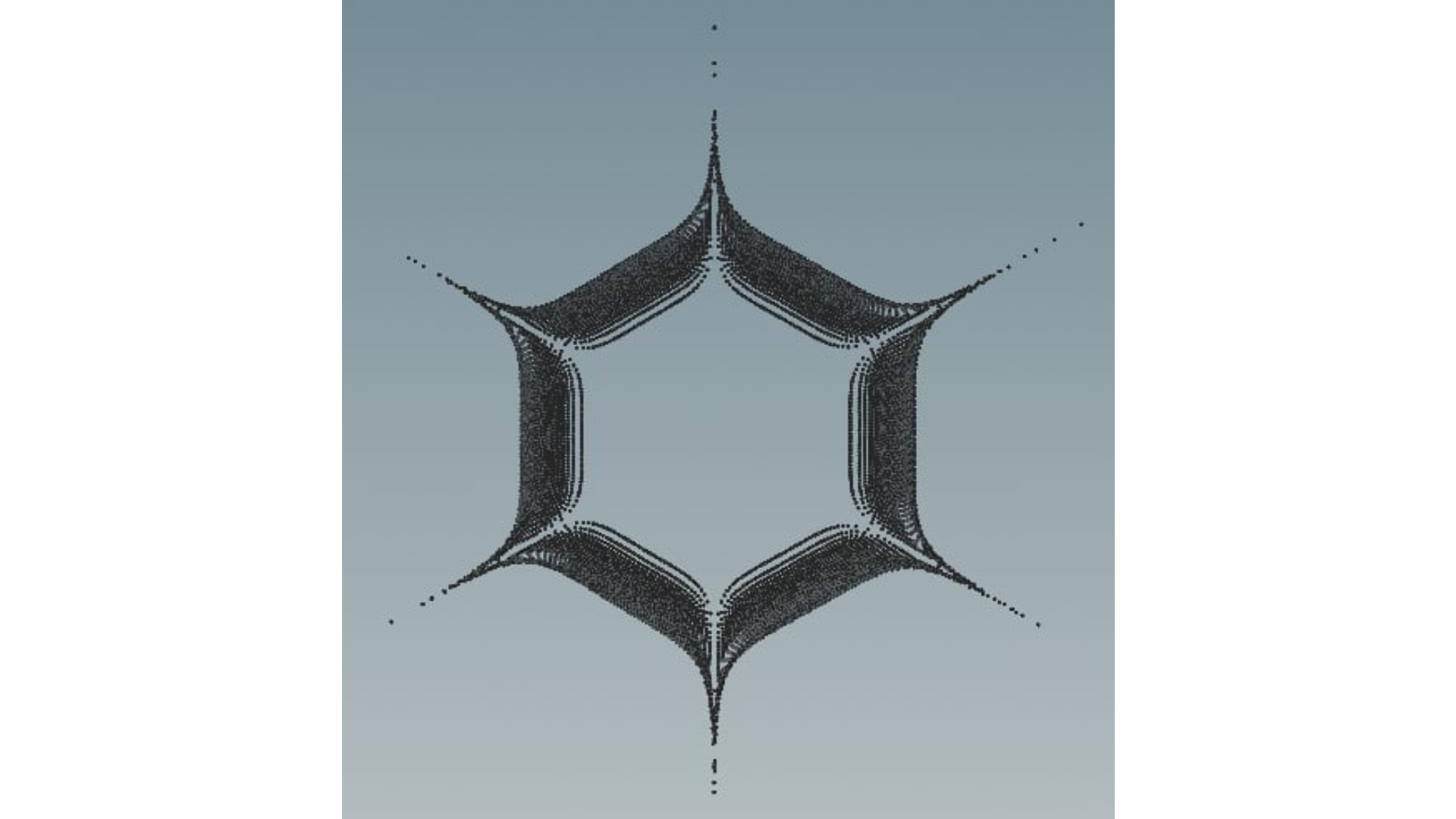
The superformula is a compact mathematical system capable of generating a wide spectrum of forms—from smooth botanical silhouettes to sharp geometric stars and shell-like structures.
I approached this equation not as decoration, but as a study of structural emergence: how minimal parametric rules unfold into rich visual diversity.
Mathematical form
A common polar expression is:
[ r(phi) = ( |cos(m·phi/4)/a|^n2 + |sin(m·phi/4)/b|^n3 )^(-1/n1) ]
Key parameters:
- m → rotational symmetry
- a, b → axis scaling
- n₁, n₂, n₃ → curvature, sharpness, and continuity
Sampling (\phi \in [0, 2\pi]) and converting to Cartesian space:
- (x = r \cos\phi)
- (y = r \sin\phi)
produces a closed contour for each parameter configuration.
Procedural exploration
Rather than targeting predefined shapes, the focus is on exploring parameter space:
- Systematic sweeps to map families of forms
- Rejection of degenerate or unstable solutions
- Layering and temporal interpolation between states
- Observation of transitions where structure appears or collapses
This shifts the process from drawing shapes → to discovering behaviors inside a system.
Why this matters
This experiment reflects a central idea in my work:
Complex visual structure can emerge from extremely simple rules.
The superformula becomes a minimal laboratory for studying:
- emergence
- symmetry breaking
- continuity vs. fragmentation
- control vs. unpredictability
These questions extend beyond graphics into scientific visualization, generative design, and procedural modeling.