
Procedural Infrastructure System (Modular & Parametric)
I build modular, parametric infrastructure systems (pipes, utility networks, mechanical assemblies) designed for real-time simulation and scalable assembly.
Hero (5-second impact)
This is a system-first workflow, not one-off modeling:
- parametric controls drive asset behavior
- modular parts interoperate through shared rules
- outputs stay stable for real-time runtime assembly
If the system logic is weak, the whole assembly collapses.
The "Modular Infrastructure" System Diagram
Input Layer (Curves & Points)
- User-drawn paths
- Point clouds defining network flow

        ↓

Logic Engine (The Brain)
- Socket logic: automatic junction detection
  - T-sections
  - L-bends
  - Crosses
- Scale enforcement for modular fit
  - Consistent piece sizing across variable lengths

        ↓

Parametric Controls (The Sliders)
- Geometry
  - Pipe diameter
  - Wall thickness
  - Flange frequency
- Condition
  - Procedural rust maps
  - Dents
  - Dust accumulation

        ↓

Output (Simulation Ready)
- Optimized topology
- Pre-set sockets for interoperability
- Integrates with adjacent systems
  - Utility poles
  - Tanks
This framing defines the project as a logic-driven infrastructure pipeline, where inputs become simulation-ready assemblies through deterministic rules.
Core Modules
The first modular target is the pipe/industrial kit:
- Pipes
- Valves
- Junctions
The system then expands to adjacent utilities once the core rules are stable.
Parametric System
Each asset is driven by adjustable parameters, not static modeling.
- geometry controls for diameter, wall thickness, and flange frequency
- condition controls for procedural weathering and wear
- scale-safe behavior so every modular piece still fits after parametric edits
Where possible, expose controls through clear Houdini HDA parameters for art direction and repeatability.
Modular Components
Assets are designed as interoperable building blocks.
- straight pipe segments
- elbows and T-junctions
- valve units and support pieces
Primary demo focus: one strong pipe system proving modular interchangeability.
Connection Logic
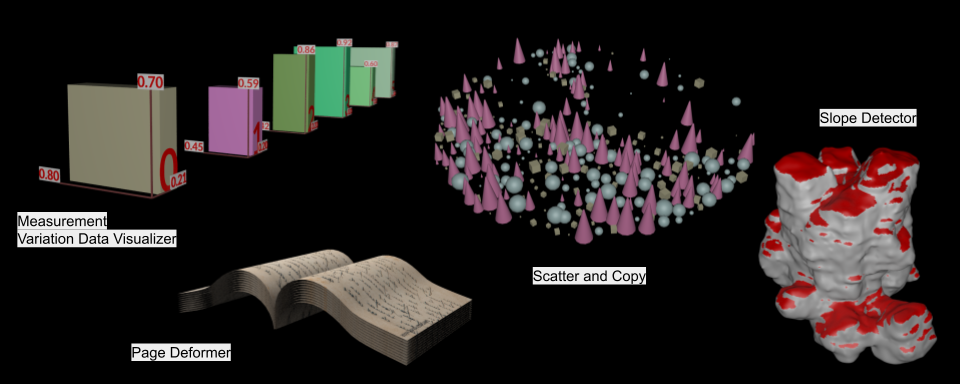
Components connect through consistent snapping and deterministic rules.
- socket-aware junction detection (L, T, and cross intersections)
- snap points and orientation constraints
- standardized scale and compatibility classes
This connection layer is the highest-value part of the system because it enables fast layout without manual rework.
Output & Integration
Systems are designed for real-time use and flexible assembly.
- optimized, clean topology
- simulation-ready output with pre-configured sockets
- interoperability with surrounding infrastructure systems
Optional: Unity-ready export presets if runtime integration is part of the production target.
Optional Extension: Beyond Pipes
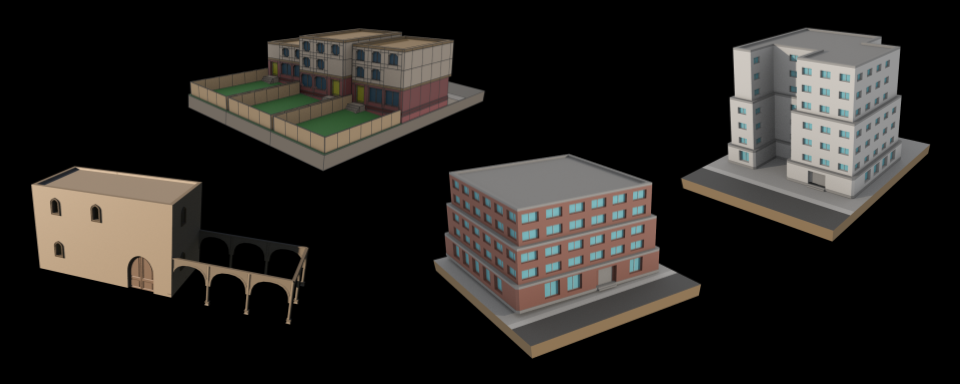
The same framework can extend to utility poles, transformers, and broader urban infrastructure kits.
This communicates that the work is not “a pipe asset set,” but a transferable procedural framework.
What this page should visibly prove
Minimum deliverable:
- one strong pipe-system example that clearly shows:
- parameters
- variations
- connections
- one small extension (for example a simple pole or box module) to prove cross-domain scalability

